Category: Book review

FINDS – Harry Watts

By , October 11, 2011 2:32 pm

BOOK REVIEW: FINDS – Harry Watts

I cannot for the life of me remember who it was, but whoever it was was an adult, and I was about 13. Nevertheless they admonished me sternly for walking everywhere staring intently at the ground. I have a feeling it might have been Victor Whyatt, a man who had previously smacked me on the head with his umbrella for my having the temerity to remark that he looked like Captain Birdseye when we had been trapped together in a doorway. If so, you might think that he would have learned not to draw my attention to things worth looking at. A rather brilliant man with a fondness for first edition books, he later became my A Level maths teacher, and his influence on my character and outlook has been huge. But that admonishment was to be particularly pivotal.

As we enter our teens there is a natural tendency for introspection which manifests itself in a form of paranoia (no one understands me), a desire to be at once an individual and yet not to stand out (I do not want to wear what my parents suggest, but see no irony in determining that I must wear the same things as my peers, and the palette from which I choose is grey, dark blue and black), and a tendency to walk everywhere listening to music and looking at the floor.

From FINDS 2011.

From FINDS 2011. © Harry Watts

Hopefully at some point we each have our own moment of enlightenment. For me, it was that admonishment. I realised the world was large and interesting, and I was small and inconsequential. This epiphany did not help me with girls, but it did set me on the path I have followed since: my head held high I have soaked up the world with vigour and enthusiasm, and nary a glance at the ground since, excepting to keep an eye out for piles of dog shit – although I appear not to have been too successful with that either, my nadir coming on a tour of Europe in the early 90s in which I famously trod in steaming piles of crap in every major capital.

From FINDS 2011

From FINDS 2011. © Harry Watts

Harry Watts’ body of work, FINDS has this morning bookended that period in my life. Forthwith I shall be turning my attention back to the ground. Not because of a renewed desire to avoid processed Pedigree Chum (although I hope that might be a happy side effect), but rather because Harry has singularly demonstrated that there is much to be derived about the world we live in by looking down.

Aside from his own work, Watts oscillates between the studios of Martin Parr and Simon Roberts as studio assistant and studio manager respectively. Yet despite the constant exposure to the output of these luminaries he has managed the signally mature feat of keeping his own eye. To be fair Parr’s presence hovers a little ghost-like in this work, but it is less confrontational and more sympathetic than it could have been. Where Parr might be brutal with the irony, Harry has chosen a more subtle approach which requires the reader to question and consider the meaning of the images – but the irony is there in spades.

From FINDS 2011

From FINDS 2011. © Harry Watts

FINDS is a series of 23 colour images printed on newsprint in a tabloid format. The newsprint approach has gained traction in recent years, Alec Soth’s The Last Days of W and Roberts’ own The Election Project being notable examples. More recently Blurb’s PDN Awards for 2011 was won by Valerio Spada with Gomorrah Girl. As more photographers turn to the notion that the artist’s approach is the best model for the future (an irony if ever there was given how violently some photographers used to react to being labelled “artists” only a few years ago), the choice of newsprint has considerable appeal. It is relatively inexpensive, somewhat ephemeral, and harks back to the possibilities of a bygone era when the whole raison d’être of the photographer was to get their pictures in the papers.

Aside from the title and the admission that it is “by Harry Watts” on the front, and details of designers (Birch), publishers (Black Box Press), and the logo of the Brighton Photo Fringe on the rear, there is no text at all. Depending on your point of view this could be construed as a huge oversight or a touch of brilliance; my own preference is for the latter. In fact so much so that when I asked Harry for permission to reproduce a few of the images for this review and he asked if I wanted a statement from him, I quietly demurred. The beauty of this body of work is in its ability to force – and no, that is not too strong a word – the reader to question the things that they find. These finds are things that Watts has found, and in so finding them he has found himself finding his findings somewhat out of kilter. I believe that having found them he wants others to find them too. Indeed, unless I am wrong his preferred method of distribution for this “book” was to dump copies in various places and leave people to find them for themselves.

From FINDS 2011

From FINDS 2011. © Harry Watts

Assuming they were found, what might readers find? Pointlessness, futility, and humankind’s bizarre capacity to expend energy for no apparent reason. For example, why bother to use a ballast bag that has burst? Why sweep up rubble but then just leave it in a pile? Where is the warning for the broken warning lamp? Every one of Watt’s pictures asks these kinds of questions. They are not critical or accusatory, rather they offer a reflection of our own folly. We all do these things without a second thought. Harry Watts has found them and represents them to us so that we can find them too.

In a sense what Watts does so effectively is hold a mirror up to the irrationality of much of what we do. What is recorded in these pictures might be the flotsam and jetsam of modern urban living, but the subjects are metaphors for the more grandiose lunacies that society perpetrates with worrying regularity. As such FINDS is that rare beast: a body of work by a young artist that is clearly about a social issue and not about the artist. FINDS does not so much scream “look at me”, but whispers, conspiratorially, “look at us”.

So with Victor and Harry both giving conflicting advice on where I should be looking, I think I have reached an age where I need to start ignoring such advice. Now, who was it who told me to stop staring at my navel…?

*   *   *

With thanks to Wayne Ford for sending me FINDS, and apologies to Harry for calling him an artist if he hates that epithet.


Phineas’ Friends – a photostory

By , September 2, 2011 3:25 pm

For the first three weeks of his life, Phineas was a model baby, but on the Thursday night of that third week something changed. By six o’clock in the morning his mother was sure that all was not as it should be. She took him to the local hospital A&E (Accident & Emergency department). Unknown to her, that particular A&E had recently gone to a twelve hour opening as a prelude to being closed altogether. As a consequence there was only an on-call GP. His verdict? “It’s just a virus, take him home. He’ll be fine.” Up to a point he was right.

Three hours later Phineas’ mother trusted her instincts and took him to another hospital to get a second opinion. He was admitted immediately.

phineas in intensive care at the Evelina Children's hospital

Phineas in the intensive care unit at ECH, May 2010. Photo: © Michael Cockerham 2010

What followed was a battle to save his life and diagnose the problem. By the Sunday afternoon his condition had deteriorated so much that he was retrieved to the Paediatric Intensive Care Unit (PICU) of the Evelina Children’s Hospital in Central London.

Phineas’ Friends is a photographic study of the doctors and nurses and clinicians that were involved in treating him during his six days at the Evelina. It is a study that forces the reader to challenge naturally held preconceptions about the size of modern medical teams, and indirectly asks the question: if all these people are necessary to a treat one baby with an infection, who in this new age of austerity can we afford to do without?

*    *    *    *

Phineas is my third son. His mother, Laura, is my wife. Any parent who has ever asked a doctor if their child is going to die, and been met with a long pause and a non-committal answer, will have some idea of the emotions that were raging for us at that time. We were lucky. Although his condition was life threatening, he was in the best hands. Laura travelled to ECH in the retrieval ambulance with Phineas. By the time I got there the PICU team were hard at work stabilising him, and Laura, though still beside herself with worry, was comforted with the feeling that he was in the best place to get better.

Fatima Meho

Fatima Meho. Paediatric Staff Nurse, Beach Ward. Provided nursing care for Phineas on the ward. Photo: © Michael Cockerham 2010

The doctors in PICU were able to stabilise him sufficiently that he was moved out of intensive care onto Beach Ward on the Monday afternoon. From then on it was about supporting him as he got better, and trying to establish exactly what was wrong with him.

From the outset the doctors were fairly certain that he had a viral infection. The problem was that without knowing which virus, it was difficult to know exactly how he should be treated. At his worst Phineas had been cannulated to all four peripheries, his blood sugar was perilously low, his temperature was dangerously and stubbornly high, and he was on a CPAP (continuous positive airway pressure) machine to help him breathe. He was having bloods taken every hour or so, he had chest x-rays, and at one point they attempted to put a long line into him because his blood sugar was still dropping and he was on the limit of what could be given to him as a peripheral infusion without burning his veins.

Laura never left the hospital, only leaving his bedside to wash and eat. Over time it became clear that he was improving, but still the tests continued. Lumbar punctures, electro-encaphalographs, ultrasound brain scans. More infusions, more drugs.

Dr Emma Aarons

Dr Emma Aarons. Consultant Virologist. Ensures any patient with possible viral illness has the right investigations, and where tests show viral diagnosis that the appropriate care is given. Photo: © Michael Cockerham 2010

On the Wednesday afternoon I was sitting with Phineas while Laura got some lunch. Staff nurse Fatima Meho was attending to him while I flicked through that week’s Sunday Times Magazine. The cover story was about a patient in the renal ward at Great Ormond Street Hospital. I held the magazine open for Fatima to see and remarked how ironic it was that the story should be published just I was sitting in Beach Ward (the Evelina’s renal ward) with my son. “No one ever writes about us,” Fatima replied. I asked her what the difference was between Great Ormond Street and the Evelina. “Nothing,” she said. Both hospitals have the same specialisations, only the former is world famous and leverages that fame effectively to raise funds. I have to admit that I had never heard of the Evelina until I needed it.

It was Fatima’s response which set me thinking that I should document Phineas’ story and get some publicity for the hospital. But what was the angle? I did not want to rehash a story that has been done many times before. The fact was that although it was important to me, it was not significant to anyone else. If I was going to publish his story, it needed an angle.

The following afternoon Laura and I got a visit from three doctors from the Infectious Diseases Directorate. At first I was struck by how different these three characters were. Nuria Martinez-Alier, Ian Plumb and Emma Aarons seemed at first an unlikely trio, but it quickly made me reflect on all the different characters we had come across during Phineas’ time in hospital. Not simply the diversity of characters, but the sheer numbers of people involved. I had my angle.

Dr Marilyn MacDougall.

Dr Marilyn MacDougall. Paediatric Intensive Care Consultant. On-call when Phineas was admitted to PICU, she made the decision to retrieve him. Authorised the retrieval team and responsible for his initial treatment. Photo: © Michael Cockerham 2010

Over those six days Phineas was treated by about one hundred clinical specialists, about four fifths of them at the Evelina. There were doctors, consultants, registrars, nurses, matrons, ward sisters, students, phlebotomists, radiographers, metabolic specialists, virologists, and these were just the ones that actually saw him. There were as many, if not more, clinical scientists and technicians analysing and interpreting the various tests he was subjected to and samples taken from him. There was the ambulance technician and the retrieval team who collected and treated him on the journey to the Evelina. There was the counsellor who was there for us as parents.

As a photographer I found myself thinking about all the hidden talents within this huge team of people – the unsung men and women whose work as technicians and scientists underpin the decisions that the doctors make and the nurses carry through. The doctors get the plaudits, but the reality is that all these different facets of modern medicine need to work together to produce the outcomes that we as patients and parents yearn and pray for.

The more I thought about all these people, the more I kept thinking about Richard Avedon’s seminal work The Family, and more recently of Nadav Kander’s Obama’s People. Both these projects used portraits shot against plain backgrounds to highlight the differences in character – the repetition of style and of people was the motif, and yet it is this approach that highlights the enormous differences from subject to subject.

Tom Walton.

Tom Walton. Biomedical Scientist. Analysis of urine by gas chromatography and mass spectroscopy. Photo: © Michael Cockerham 2010

It is a form of typological study that was perhaps made famous by Bernd and Hilla Becher and their studies of blast furnaces, and taken up by other photographers including Donovan Wylie and his study of the Maze Prison. The difference is that with people the subject has the capacity to introduce its own character and agenda to the way that they are recorded; it is necessarily a two-way process. Certainly these are “my” portraits and they reflect something of my intention, but as each individual sits for me, they have control over the face that they present. For a good portrait there must inevitably be a balance in that “dialogue” between the subject and the photographer.

Avedon chose to shoot in large format black and white, with a simple white background. His subjects were the men and women who ran and shaped America. From Gerald Ford as President to Roger Baldwin, the founder of the American Civil Liberties Union.

Kander chose to use a similar approach to document the nascent administration of Barack Obama as he was about to take office, but in this case he shot in colour, with a creamy background. The images have been digitally worked to some extent, putting a shadow close in behind each person, and emphasising the texture of each person. There is a kind of hyper reality about them which makes each face fascinating to look at. Although the work was regarded by some as something of a departure from Kander’s norm at the time, it was nevertheless imbued with his artistic sensibilities. It had his “signature”.

Sean Hayes.

Sean Hayes. Retrieval Technician. Part of the retrieval team that brought Phineas back to the Evelina PICU from Darent Valley Hospital. Photo: © Michael Cockerham 2010

Both of these bodies of work were successful for the combination of simple, arresting portraiture and the fact that the subjects were either household names, or held positions of power that made their faces worthy of closer inspection.

For Phineas’ Friends I felt certain that a similar approach would be ideal. To the best of my knowledge no one had taken this approach with a medical documentary before, and the strength of the story would reside in the fact that as the reader moved through all of these portraits it would dawn on them that the common link for all of them was a single patient – a baby. None of these people are famous, nor was the patient. But the pull of such a small child as a narrative element is undeniable. Perhaps more importantly, we are all able to see ourselves in that baby. And when we do Phineas’ friends become our’s. These are our doctors and nurses and technicians and scientists. These are the people that keep each of us alive if we need them. As Phineas is a metaphor for all patients, so too his friends are a metaphor for all the clinicians working in all the hospitals around the world. Once we realise that, the old narrative beloved of dramas and documentaries seems a pale approximation of the truth – modern medicine is not a doctor and a nurse, it is a vast team of specialists.

Habiba Kawu.

Habiba Kawu. Neonatal Staff Nurse. Agency nurse providing constant care and monitoring of Phineas' condition while in intensive care. Photo: © Michael Cockerham 2010

Nevertheless I was conscious that for the project to work, the standard of the portraits needed to be high. Each image had to work individually while they all worked together as a set. The choice of background, the style of lighting, the choice of lens, and the subtlety of any direction I gave would have to complement the image and the intent. I wanted very much to give viewers something of the experience of the parent or the concerned relative. Hopefully I have succeeded.

*    *    *    *

I decided on a whim to enter the book of Phineas’ Friends in this year’s Photography Book Now Awards. Although it did not win, it was shortlisted in the Documentary Category, and as a result was eligible for the People’s Choice Award. To have been shortlisted by the jury in the first place is a tremendous honour. But more importantly it gave me a glorious reason to push the work in front of people as I tried to garner all the votes I could. I was able to enlist the help of a great many influential people around the world, and that in itself has helped in my quest to raise the profile of the hospital. All of you who voted, thank you. Your support means a great deal. But it does not end there.

As I intimated earlier, my motivation from the outset has been to help publicise the work of the Evelina and perhaps raise its profile just a bit. As a part of that process, Blue Filter has published Phineas’ Friends in three formats: as an iBook for the iPad and iPhone, as a small format paperback, and as a limited edition signed hardback. All of these can be ordered from this site, and the profits from the sale of these books will be donated to the Evelina Children’s Hospital.

Please, buy the iBook or the paperback. If you are feeling flush and want some exclusivity, buy the hardback. But whatever you do, encourage all your friends, family and acquaintances to read this post and buy the iBook too. If you just want to donate with nothing in return, you can do that as well.


*    *    *    *

Buy the iBook for iPhone & iPad

Buy the paperback

Buy the limited edition hardback

If you would like to support the Evelina Children’s Hospital, some of the Evelina Team recently undertook a sponsored climb up Mount Kilimanjaro, and you can still donate now. Their target was £400,000, with the current total raised standing at £396,616.63. It is to this fund that monies raised from the sales of Phineas’ Friends will be donated, but if you would rather donate directly, please click here.

Family

By , November 17, 2009 1:21 pm

BOOK REVIEW: Family

If all the photographs ever taken were sorted into subject categories, it is probable that the biggest single pile would be that which covered the family.

Ever since Kodak suggested to the general public that “you push the button, we do the rest”, camera owners the world over have seen the importance of immortalising family events.  Christmas; the family holiday; children and their birthday parties; visiting relatives.  These are the photographs that are most treasured.  Intimate, personal, and largely unseen. They are the items most people would claim to miss the most if their homes were burned to the ground.

Indeed, historians have for some time recognised the collective importance of such images, giving a visual narrative to history and changing social moirés.

One area of family photography has however remained largely unexplored, and that is how professional photographers photograph their own families.  How do people who spend their lives taking great photographs relate to their wives, husbands, children, parents and siblings?  Are they aloof?  Are they intimate?  Do they apply the exacting standards of their professional work to the chance shots of the children at play?  Family, a new book from Phaidon sets out to examine this curious relationship.

Subtitled Photographers Photograph Their Families, this is not a commissioned piece, and it is not restricted to current or even recent photographers.  Rather it is a genuine attempt to curate into one body some of the private and intensely personal photographs of 56 photographers from around the world, and throughout the history.

Having recently become a father, I may be more receptive to its charms than others, but Family comes across as a rather wonderful book, to which the word gentle is well suited.  It not only allows a greater insight into the characters of some well known photographers, but compels the reader to re-examine their own approach to portraying their family and friends.

Family, edited by Sophie Spencer-Wood with preface by Henri Peretz, Phaidon 2005. £24.95.   ISBN 0-7148-4402-0   www.phaidon.com

This review was originally written for the Photographic Journal

We English – Simon Roberts

By , October 28, 2009 2:25 am

BOOK REVIEW: Simon Roberts – We English.

Being away from home for any length of time usually results in a longing for the familiar, but for Simon Roberts his marathon trip round Russia in 2005 (resulting in the critically acclaimed Motherland) raised questions rather than longings. As he explored what it means to be Russian and the relationships Russians have with their landscape, he found himself increasingly considering what his relationship was with his own country and nationality.

Roberts is about as middle English as it is possible to be. Brought up in the the Surrey commuter belt, the son of a Cumbrian woman and a London man, his childhood was one that would be recognisable to most middle class Middle Englanders growing up in the 70s and 80s. His recollections of childhood holidays in the Lake District and at the seaside informed much of his appreciation of the English landscape, inevitably leading to his questioning how much this shaped his own sense of nationality. Indeed, what does it mean to be English, as distinct from Welsh, Scottish, or the more general British?

Cover of We English by Simon Roberts

Cover of We English by Simon Roberts

Facing the sight of Russians at play in the Siberian landscape he began to examine the nature of the relationship we English have with our homeland, and before he had finished shooting Motherland his sights were set on the next project. Thus two years later, with Russia well behind him he persuaded wife Sarah and daughter Jemima to join him in a camper van on a ten month journey around England to observe the English in their environment, and possibly find out who he was in the process.

One of the curious things about this body of work is that it is intrinsically more distant than Motherland; how is it that an English photographer could feel more intimate with foreigners in a foreign land than with his own countrymen at home? An obvious consideration is that we are all drawn inexorably to the exotic, it holds greater fascination for us and paradoxically our very closeness to “home” can make photographic intimacy that much harder to achieve. Indeed, Simon has drawn attention to the fact that virtually nothing has been produced on England in the last ten years by British photographers; cheap flights and myriad conflicts having proven a stronger draw for his contemporaries as they set out to make their mark as photographers elsewhere. The strength of We English comes from his determination not to battle that awkward closeness, choosing instead to embrace the distance and make it an intrinsic part of the work. He employed the questions he had regarding his own national identity to give a level of objectivity to his work that is arresting. It is perhaps worth noting that Simon is a human geography graduate, and although the artistic approach of We English is very different to Motherland, it seems clear when taken together with the breadth of his earlier more photojournalistic output where his interests and natural inclinations lie.

In his research Roberts considered the rich history of visual documentary that exists about England, both photographically through the likes of Tony Ray Jones, Bill Brandt and Martin Parr, and in the work of painters like Turner and Constable; he also took inspiration from further afield, and the influence of the Flemish masters Bruegel and Avercamp is hard to ignore. To his credit he used this research not so much to provide inspiration for his own objectives, but to gain a deeper understanding of the narratives that different artists have employed. The danger – of which he was all too aware – of setting out on this kind of project is that the work you produce can become either a pastiche or a derivative of what has already gone before.

Roberts was determined that his work should stand on its own merits even if it inevitably alludes to the work of those in whose paths he has walked. Frequently referred to as “this green and pleasant land”, a photographic examination of England as landscape alone could easily degenerate to chocolate box sentimentality, but We English is not simply about landscape, it is about the place of the English within it. While he chose to stay away from individuals, people are a vital part of the pictures Roberts has made, but the personality portrayed is of the English as a whole, a portrait that is at times touching, curious and barmy. But it is neither critical nor saccharine, only observational.

Much of the imagery is about borders and margins; those places where one thing ends and another begins, and how these delineations make statements not only about the landscape and its uses, but also about the people we are. Sometimes the resulting photographs are inherently beautiful, but more often the beauty lies deeper, in a quiet understanding that while we are each to our own in pursuit of happiness, collectively we are English.

The more you contemplate We English the clearer it becomes that Roberts’ real artistic allusion is rather clever. He could have pursued the immediacy and reportage style of Kate Schermerhorn and her brilliant work America’s Idea of a Good Time, but instead chose the more considered approach of large format photography to reflect on the leisure activities that define who the English are within the landscape, rather than who they are forced to be. To put it another way, most of us work to live, and the work we do is often happenstance. But our leisure time, chosen by us as individuals and being so precious, compels us unwittingly to make a personal rather than forced connection with the landscape we inhabit. To that end the work he has produced has more in common with L S Lowry than some of the artists Roberts has been compared to. But whereas Lowry was intrigued by the social revolution that was industrialisation, Roberts’ “matchstick men” are drawn to whatever green they can find in the name of unwinding. It is here that the fine detail of the large format comes into its own, each image a tableaux depicting numerous events and encounters: each part significant, each image greater than the sum of these parts. A whole play, a whole commentary within an instant. And yet these works are less the decisive moment of Cartier-Bresson fame, and more the essence of a people and place inextricably linked. What Roberts shows us is that England is only what it is by virtue of the people that we are.

Mad Maldon Mud Race, River Blackwater, Maldon, Essex, 30th December 2007

Mad Maldon Mud Race, River Blackwater, Maldon, Essex, 30th December 2007

There is another thing that makes We English different, and that is the word “we”. Roberts wanted his work to be a collaboration, and while it inevitably reflects his view of things – nothing artistic can ever be truely objective – he knew from the outset that if his journey was to produce anything of substance it would need to draw on the knowledge, whims, and character of the English themselves. Through his blog and brilliant use of The Times, the BBC and many local newspapers, Simon encouraged people to tell him about their England, and the events that shape their lives. As a result We English is a collaboration; a genuine reflection of the English at the start of the 21st century.

We English has all the hallmarks of a great body of work by a photographer of considerable depth. It shuns the flashy “in-yer-face” tactics so commonplace in favour of quiet thought and subtle observation. It is work that repays the reader through frequent reexamination: full of humour, but more subtle than Erwitt; full of commentary, but less judgemental than Parr; full of beauty, but without cliché.

The book is large format and elegantly produced (although my copy sadly has a production fault across my favourite image – it must be someone else’s favourite too!), with exquistely detailed bordered images set for the most part one to a double page spread, with an insightful introduction by Stephen Daniels. But if you really want to get the most from this body of work you need to view the prints at exhibition (the first major exhibition of We English in the UK will be at the National Media Museum in Bradford from March 12th to September 5th 2010) and just as importantly spend a lot of time absorbing the wealth of detail and background information on the We English website.

For all his innate Englishness, Roberts chose to view the English in their landscape from the perspective of an outsider in large part because he was, and remains, uncertain of what it means to be English himself. In short a road trip at home is about discovery of oneself as much as it is about discovery of place. His continuing journey of self-discovery will undoubtedly be welcomed by many, and deservedly so.

We English – Simon Roberts, Chris Boot Publishing, 56 colour photographs, 112pp, Hardback, £40.00, ISBN 978-1905712144. www.chrisboot.com

Photographs – René Burri

By , June 12, 2009 8:02 am

BOOK REVIEW:  René Burri – Photographs

There are some photographers you really ought to know better, but don’t. They go quietly about their work, unassuming, not wanting to do the obvious or offend their subjects. René Burri is that photographer. A man not afraid to talk about the untaken photographs; the images missed because he chose to miss them. His is a considered approach, one that has resulted in many iconic images and a deserved reputation among his colleagues as one of the giants of twentieth century photodocumentary.

A Magnum veteran, it is unsurprising that he should have sought to publish a major retrospective of his work, and still less surprising that he should do so through Phaidon, masters of the photographic monologue who have published over 15 books by Burri’s Magnum colleagues.

Born in Zurich in 1933, Burri came into photography almost by accident. From childhood he was unquestionably artistically inclined, his mother saved wrappers to help feed her son’s demand for drawing paper, and his attendance at Zurich’s well regarded art school was almost inevitable. Burri, however, was initially turned off photography by the pungent smells associated with the darkroom, and it was only when he saw the lighting rigs of the studio, and their inherent Hollywood glamour that his thoughts turned to the possibilities photography might offer.

A naturally inquisitive man, Burri found Switzerland claustrophobic: the mountains obscured his view of the world beyond. Furthermore, the methodical order and neutrality so often associated with Switzerland, and ingrained in Burri during his training by the esteemed formalist, Hans Finsler, became something Burri wrestled with all his life. The struggle though, was not to break free from its strictures, but to harness its potential as a tool to be used so effectively in his work.

This retrospective is a celebration of Burri’s personal work. In common with many photographers he disliked the restrictions associated with commissioned work, and continues to see the camera primarily as a means of personal expression. Nevertheless he took such assignments based on his need to pay the bills, and naturally they provided many of the opportunities to further his quest for personal satisfaction, and importantly led to long associations with a number of publications, in particular the Swiss periodical Du. Indeed, the closing chapters of the book detail Burri’s many exhibitions and publications, and tantalisingly reproduce a handful of magazine spreads – the only colour reproductions included.

The book is cleverly designed, having the feel of a catalogue, but the permanence of something more special. It is a testament to Burri’s remarkable and unassuagable eye that after nearly 500 pages the reader is left wanting more, and knowing that what has been revealed is only a taste.

René Burri Photographs, Phaidon Press, 378 Duotone and 44 colour illustrations, 448pp, Hardback, £59.95, ISBN 0-7148-4315-6. www.phaidon.com

This review was originally written for the Photographic Journal

The Fat Baby – Eugene Richards

BOOK REVIEW: The Fat Baby – Eugene Richards.

Every now and again someone has an idea so blindingly obvious it is difficult to see why it has not already been done.

Take the Magnum photographers for example.  They spend their lives chasing stories; stories are their raison d’ètre.  Sure they publish books on particular stories:  Larry Towell has The Mennonites, and Paul Fusco has RFK Funeral Train.  They even have collective books on given stories, like New York September 11, and Arms Against Fury, but generally they are retrospectives.

The Fat Baby is the new book from Eugene Richards, one of the brightest stars in the Magnum firmament.  It bucks the trend with something really unique: a retrospective of stories.  Rather than put together a large coffee table tome of great images taken out of context which would undoubtedly sell, Richards has chosen to publish the original stories as he took them, with his own notes or text alongside.  This may not be ground breaking stuff, but on a book of this size (432 pages with some 300 duotone images) it feels as though it is.

Richards’ work is powerful, poignant and eloquent.  The images stand on their own merits in isolation, but put into the context originally envisaged the effect is magnified.  They really do become greater than the sum of their parts.

Now sixty years old, Richards is well established as one of the leading exponents of the photoessay, and could easily have chosen to use work from throughout his distinguished career.  Any such retrospective would have been well received, but one suspects that he might look upon the retrospective as the preserve of retired photographers.  Make no mistake; Eugene Richards is very active, and The Fat Baby draws only on his considerable pool of recent stories. 

Arguably Richard’s greatest achievement, and indeed the reason he is able to gain access to groups of people who might otherwise be hostile to his advances, is the manner in which he gives voice to other people’s stories without being judgemental.

While there are many photographers who view “concerned photojournalism” as an invitation and means to voice their own views, the real genius of Richard’s narrative is the manner in which he presents deeply moving stories and leaves the reader to form their own opinion.  This is no small achievement, and one suspects it is a large part of his reason for producing the book.  While his Magnum credentials give him considerable clout when it comes to the use of his images and captions, he nevertheless often finds his photographs being used as mere illustrations to accompany text, which can put a completely different slant on a story to that which he may have intended.

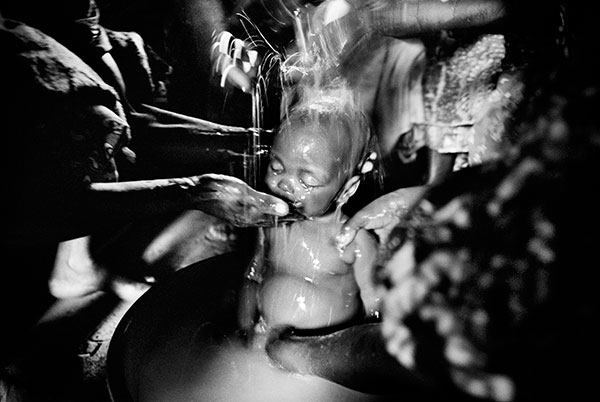
The Fat Baby is a collection of 15 essays, with subjects ranging from gay parenting issues in Tuscon (Here’s to Love), to the famine suffered by the villagers of Safo in Niger (The Fat Baby – from which the book takes its name).

By reproducing the notes and keeping the original narrative of the stories together, it invites the reader to consider the issues: it provokes a response.  No one who professes to support what documentary photography is about should ignore The Fat Baby.  It is a monumentally important book.  Not simply because it is well produced, but because it actually gets back to the root of why pictures such as these are made in the first place.

The Fat Baby by Eugene Richards, £59.95/€90.00, Phaidon Press, March 2004.

This review was originally written for the Photographic Journal

Afterwar – Lori Grinker

BOOK REVIEW:   Afterwar – Lori Grinker

We are all inexorably drawn to war.  Tales of courage under adversity, heroism under fire, acts of selflessness and love, men in uniform and the pomp and technology of the military in action.  It is at once fascinating, horrifying, shocking and guaranteed to provoke a response.

It is no wonder then, that war has always exerted a pull on photographers.  Some go to make a name for themselves; others hoping their work might make a difference.  Some go for the rush.  Whatever the motivation, they are usually divided into two camps: those who look for the dramatic images of combat in the front line, and those who turn to the plight of the civilians caught in the crossfire.

New York based photographer Lori Grinker has uniquely found a different way to portray war.  When the truces are signed and the guns fall silent, the press turns its attention elsewhere, but the sights, sounds, smells, relationships and losses are necessarily etched into the psyches of the combatants.  While other photographers have concerned themselves with showing the man within the war, Grinker has strived to portray the war within the man.

Afterwar manages the substantial achievement of personalising the conflicts of a century.  Men and women caught in the dehumanising chaos of war are left to reconcile their experiences with their own fundamental humanity.  Some meet it head on, others try to file it away, and get on with their lives.

Readers looking for groundbreaking photography or iconic images will be disappointed with Afterwar, but they will also be missing the point.  Allied with the testimony of her subjects in their own words, Grinker’s colour photographs achieve something that has eluded every other photographer: they deglamourise war.  While each of the subjects is portrayed with incredible dignity the overall effect is unremittingly dark and depressing.  War is hell.

Afterwar is elegantly designed, using a reverse chronology to take us back from a taste of the recent war in Iraq through all the major conflicts of the past century to the First World War.  It crosses continents, cultures and languages setting each conflict in context.  Ostensibly each person in the book represents a survivor of war, but their experiences have necessarily robbed them of something precious, and mankind as a whole is diminished by what they went through.  If there is any justice Afterwar will find its way to the desks of all those charged with calling men to arms.

Afterwar, Veterans from a World in Conflict is published by de.MO, and priced at £29.00.  Hardback ISBN 0-9705768-7-0.  248 pages.

This review was originally written for the Photographic Journal

Panorama theme by Themocracy